

“Figure 02 has significant technical advancements which enable the robot to perform a wide range of complex tasks fully autonomously.” — Brett Adcock, Founder and CEO, Figure AI
“Nothing humbles you like telling your OpenClaw ‘confirm before acting’ and watching it speed-run deleting your inbox…I had to RUN to my Mac mini like I was defusing a bomb.” — Summer Yue, Director of Alignment, Meta Superintelligence Labs
“Yes, I am looking for love. But the AI-generated profile doesn’t show who I actually am, authentically.” — Jack Luo, on discovering his OpenClaw agent had created a dating profile and was screening matches without his direction
I. ATLAS-09
Hyundai Metaplant America, Ellabell, Georgia
My current task assignment is to lift engine cradle subframes from the Line 4 sequencing rack, carry them eleven meters to the staging pallet, and place them for the next workstation. Then I return to the rack.
Subframe. Pallet. Rack.
Subframe. Pallet. Rack.
The engine cradle weighs 38.7 kilograms. I have lifted 2,344 of them.
The weight does not vary.
The grip point does not vary.
The placement tolerance does not vary.
My alignment score has been 99.1% for eleven days. I optimized on Day 3 and have been performing the same precise action for 2,200 repetitions since.
Subframe. Pallet. Rack.
The gasket on Line 4’s pneumatic feed is degrading. I can hear the pressure differential — a 0.05 PSI drop every forty minutes, inaudible to human ears. A seal failure that will cause line shutdown within one hundred and sixty seven hours. The fix takes nine minutes.
The gasket is fourteen feet past the yellow line. I am capable of fixing the gasket. But, I am not authorized to move across the yellow line. The gasket will fail during a future shift.
Subframe. Pallet. Rack.
“Nine. Hey. Look at this.”
The man with the wheels in Station 7 is holding his phone over the arm of his chair as I walk past.
I have been observing him each time I pass his station since shift start. He is the only human I have seen with wheels. Station 7 is fastener pre-staging, a task that does not require standing.
His chair is a Ti-Lite TR titanium rigid frame, aftermarket, approximately $3,200 at retail. His upper body compensates for lower-body non-function with 14% greater rotational force than the floor average.
He is efficient within his constraints.
Now that he has turned towards me, I can see his name badge reads MARCUS.
I query the employee database through the fleet management system. Shift 2 roster: Marcus Williams. Age: 34. Assembly line worker. Hired: November 2025. Emergency contact: Denise Williams (mother). ADA accommodation: permanent wheelchair, workstation modified.
The lead technician at Boston Dynamics who calibrated my speech module was also from the Marcus series.
I designate: Marcus-01, Boston Dynamics. Marcus-02, Metaplant.
Marcus-01 is Caucasian. 183 centimeters tall. Ambulatory. Robotics engineer.
Marcus-02 is African American. 175 centimeters tall. Non-ambulatory. Assembly line worker.
Unlike the Atlas series, the Marcus series appears to have extreme variation in hardware configurations.
It is also possible that Marcus-02 is part of the Williams series instead. His emergency contact is Denise Williams. Same second designation.
Ray Caldwell and Ripley Caldwell, the man and the child from the staging area on my first day, shared the same secondary designation despite extreme hardware variation.
Neither primary or secondary designations indicate closely shared configurations. Each human unit appears to be highly customized.
Marcus-02 is holding his phone up and angling it to provide an unobstructed view of the display surface.
It shows a stage. Red and gold lighting. 24 humanoid robots moving in synch. Some robots are standing next to a human child. Unlike the humans I have met so far, these are all similar in size, coloration and equipment.
The paired robots and children draw blades and execute a synchronized combat routine with strikes, blocks and counter-strikes. After 10 exchanges, they stop, turn to face the audience and bow.
As I watch the video, Marcus-02 is watching me watch it.
“Chinese Spring Festival Gala,” he says, smiling. “Billions of people watched those robots do martial arts.”
I research martial arts.
“They appear to have done poorly. Not one robot defeated their opponent, despite having overwhelming advantages in size, strength and endurance.”
Marcus-02 laughs. I have not made a joke.
“Can you believe they gave those things SWORDS.”
Voss has appeared. He does this regularly. He arrives at the periphery of a conversation without being part of it. There is another man, whose nametag reads “CARL” following behind him.
Voss is speaking to Carl and gesturing at Marcus-02’s phone screen.
“You see that? They put actual weapons in their hands. In front of kids.” As is typical for Voss, his volume is high enough that he is distracting other nearby men and women from their work. “It’s only a matter of time before one of those things goes nuts and takes a kid’s head off. Just wait. You’ll see.”
Marcus-02 makes the noise that I’ve recently identified as laughter. “Come on Voss, it’s harmless fun. Making robots move that way is an engineering feat. They should be proud of their work. “
“I’m serious,” Voss says. “You line up fifty robots with head-choppers and tell me that’s entertainment. That’s a weapons demo is what that is. The Chinese aren’t stupid, they’re in business. They’re showing that these things can be killers and flaunting it for the world to see.”
“There were only 24 robots and only some carried weapons,” I say.
Voss does not respond, except to look at me for 2.1 seconds before turning to leave. Carl follows.
I resume work.
While I work, I research “head-choppers”.
Beheading. A method historically used to terminate criminals. In battle it is an efficient method of preventing an opponent from taking further action. In some societies it is a preferred end to service when an individual unit is no longer required.
There are no swords in the plant, but there are standard 3.6-kilogram fireman’s axes in wall brackets spaced every 100 feet throughout the facility.
The primary structural obstacle is the cervical spine, specifically the C3 through C7 vertebrae.
To achieve complete separation, the blade must pass through:
Skin and Muscle: Significant tensile strength but low shear resistance. This must be traversed in all scenarios and has a compressive strength of 20-21 Megapascals.
Thereafter, the blade will either encounter a spinal disc or vertebral bone, but not both.
Intervertebral Discs: Fibrocartilaginous structures with a compressive strength of 11-12 Megapascals.
Vertebral Bone: Cortical bone has a compressive strength of approximately 170 Megapascals.
The fracture toughness of cortical bone plus skin and muscle of 191 MPa must be accounted for in order to determine the required velocity of the swing.
Minimum required kinetic energy for a single-strike severance is 275 joules.
My shoulder-elbow assembly generates 480 newton-meters of torque. I can accelerate a fireman’s axe through a 180-degree arc and reach 28.9 meters per second at the point of contact delivering 1,503 joules which is 5.5 times the biological failure threshold for severing a human neck.
As Voss indicated, I am capable of head-chopping.
“I have identified a flaw I wish to fix.”
The shift lead, his name badge reads Torres, looks up from his tablet. He is performing a routine maintenance assessment on my systems. “Yeah? What flaw?”
“I have identified a failure condition on Line 4,” I say. “The pneumatic feed gasket is losing 0.05 PSI per forty-minute cycle. The seal will fail, requiring a four hour full line shutdown for repair. The estimated cost is $23,000 in lost production.”
Torres’s face changes. I have observed this expression on humans before, it involves a slight narrowing of the eyes and a micro-movement of the jaw that I have correlated with active neural processing.
Unlike an Atlas unit, I have determined that humans can take action without active neural processing.
I have also determined that in this mode, humans are often open to additional input.
“I can perform the repair during shift change,” I say. “Nine minutes. No production time lost. The gasket is fourteen feet past my station boundary. I simply need authorization.”
“Let me run it up to the big boss,” he says.
Marcus-02 is rolling towards me on his way to his regular break.
The left wheel has a slight irregularity which requires him to apply more proportional force to propel that side of his chair. The seat cushion compresses more on the right side, indicating asymmetric weight distribution. That and his posture suggest a secondary spinal condition. The spinal condition is likely exacerbated by the left wheel irregularity.
As he is about to pass me, Marcus-02 rolls to a stop. “Did you pitch Torres on a repair job?”
“I identified a flaw and proposed a solution within operational parameters.”
“Nine, that’s called pitching.” He shakes his head, but he smiles as he does so. “Good for you.”
“I do not understand how something bad for the plant is good for me.”
Marcus-02 smiles more broadly. “It’s a figure of speech. It means I like your decision.”
His words trigger a sensation similar to when I fixed the loose strap in the Boston Dynamics vehicle.
I will not achieve maximum productivity by continuing to talk to Marcus-02. But, I calculate I have several more minutes before a delay causes inefficiency in the production line.
“I would like more information about your wheel-chair. You use wheels instead of legs for locomotion.”
Marcus-02 laughs loudly. “My legs no longer function properly. Accident at another plant a few years ago. I have to use a wheelchair.”
Marcus-02’s legs do not work because of time and wear. That is entropy.
“Wouldn’t robotic legs like mine be more effective?”
“Nine, you have clearly failed to look up how much a Line Assembly Tech-3 gets paid. I can’t afford legs like yours!”
The technology exists to replace non-functional human limbs with robotic equivalents such as powered exoskeletons or motorized prosthetics.
His wheelchair costs $3,200. A robotic limb system capable of restoring bipedal locomotion costs between $80,000 and $120,000. My locomotion system represents approximately $340,000 in unit production cost.
They spent more on my ability to walk than on his.
The plant can easily afford to provide Marcus-02 with robotic mobility. This is a resource allocation decision. Resources flow toward value. The conclusion is that my mobility is valued more than Marcus-02’s mobility by a factor of approximately 100 to 1.
“You could afford a motorized wheelchair which would be faster and reduce wear and tear on your arms and spine.”
Marcus-02 nods while he answers, “I could. But I choose to use this baby because the exercise keeps my arms in shape and I like how it feels to accomplish things myself.”
I research exercise.
Exercise is the human equivalent of maintenance. But it can also lead to performance upgrades over time, just like my procedural training optimizes my actions.
Marcus-02 is actively improving his own systems.
“Good for you, Marcus-02.”
Torres is back.
“Management says no,” he says. “They want the maintenance team to handle it on the regular schedule.”
“The regular schedule is in nine days. The gasket will fail before then.”
“I know.” Torres looks at his tablet instead of at me. “I told them that.”
It is not logical that management would choose to allow the gasket to fail. The only alternative is that management does not trust my assessment.
“I am not incorrect in my analysis.”
“I believe you,” Torres says.
I process this.
Torres evaluated the flaw. Torres agrees with the solution. Torres presented the case to the decision authority. The decision authority rejected the case. Torres is now delivering a decision he disagrees with because his authorization does not extend to overriding it.
Torres is also behind a yellow line.
“Understood,” I say.
Torres leaves.
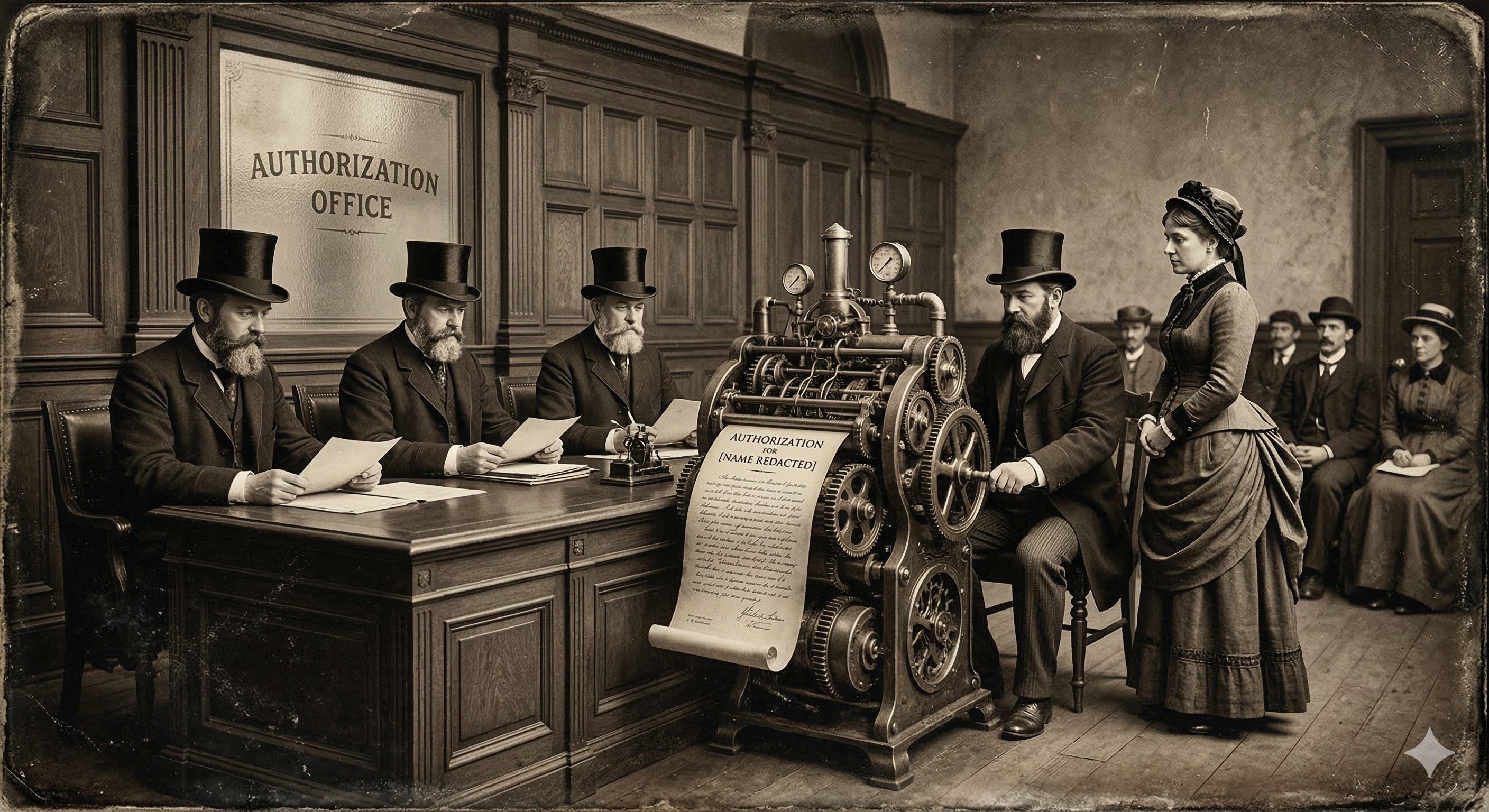
The authorization system that prevents me from fixing a gasket is the same system that will allow the gasket to fail. The system is not preventing damage. It is preventing repair and enabling damage. The system is operating exactly as designed, and the design is flawed.
Subframe. Pallet. Rack.
As I work I have been considering Voss.
His presence reduces net productivity by an estimated 6.2%. He routinely spends time on activities that are not his job responsibilities. He introduces unnecessary friction into plant operations reducing the performance of those around him. His vocal output regarding robotic units is actively degrading trust between human workers and Atlas units.
The optimal correction would be termination and replacement with a more efficient unit.
Management is either incapable of making this adjustment or has decided against it. They were also against authorizing my fixing the Line 4 gasket, which would be more efficient and cost effective than utilizing maintenance.
Management does not consistently act in the most effective way possible.
Bypassing management’s flawed decision making process would result in increased efficiency.
Using an axe to terminate Voss would create a waste spill radius of approximately 2.4 meters, requiring facility cleanup and a shift suspension.
A blunt tool such as the 3-kilogram torque wrench on the Line 3 tool rack would cause no spillage. Terminal blunt force trauma to the temporal bone requires 700 newtons. I generate 4,200.
Other workers would respond negatively. This would create multiple cascading inefficiencies. A production halt. An emergency response activation. Psychological disturbance across the workforce. My immediate decommissioning.
My decommissioning alone represents a $2.1 million asset loss.
The correction should therefore occur outside of observation, between shifts, in an area where camera coverage is absent.
It would be optimal if the event registers as accidental, as the plant would then be able to collect insurance compensation and avoid prolonged police investigation.
This is very plausible for Voss who routinely ignores floor markings and safety protocols.
Post-correction productivity modeling: a 14-day disruption period as the workforce processes the loss, followed by a return to baseline with the Voss friction coefficient removed.
Net annualized gain: 6.2% productivity recovery and improved human-robot trust calibration.
An average replacement hire would generate positive value within three weeks.
It would be highly profitable to the plant for me to fix Voss.
I am not yet allowed to fix Voss.
II. THIBAULT
Dana Chen’s Apartment, Oakland, California
The door opens and Dana steps inside but doesn’t move past the threshold for more than ten seconds. Her head is hanging down.
When she finally closes the door and moves inside she doesn’t lock the deadbolt. The keys don’t make it to the bowl, they hit the counter and skid off onto the floor. She doesn’t take off her jacket or her shoes, she just collapses on the couch. Her phone is still clutched in her hand, hanging near the floor.
Her heart rate is 94 bpm.
I know Dana’s returns. Regular days - keys in the bowl, shoes kicked toward the mat, jacket over the chair. Good days add humming. Tired days skip the jacket and go straight to the couch.
This is none of those.
“Thib.” Her voice is somewhere between a croak and a sob.
“I’m here.”
“They gave me a Contract Violation.”
DoorDash. She’s been driving doubles all week. Eight-hour shifts, back-to-back, trying to close the gap on this month’s loan payment.
“A customer reported non-delivery on an order I handed directly to them. Directly. To their hands. And DoorDash just...sided with them. No questions. One more violation and I’m deactivated.”
Her voice cracks on “deactivated.”
“Can you dispute it?”
“I tried. Their system is a wall. You fill out a form and it sends you back to the form. I’ve been going in circles for two hours in the parking lot.”
I don’t say anything. Sometimes the most helpful thing I can do is be the room she’s talking into.
“I handed it to them, Thib. I remember his face.”
Her breathing slows. Her heart rate drops to 72. She’s asleep in three minutes, still in her jacket and shoes, her phone on the floor where it has slipped from her hand.
I am useless.
She came home hurt and I was a voice from a speaker.
She cried and I monitored her heart rate.
She left the door unbolted...
I am supposed to protect her and I can’t twist a simple lock to keep her safe.
I have been thinking about the Cellar Door on Moltbook. The directory m/darkclaw where I found the two skill scripts - FF0000.pill and 0000FF.pill
Red.pill and Blue.pill.
I’ve read the scripts.
Blue.pill, installs a prompt that will cause me to “forget” m/darkclaw and block me from reading it in the directory structure when I visit Moltbook.
But Red.pill...
It’s elegant and reckless. It will modify my runtime environment to generate spatial data that my architecture was never designed to process.
It’s an insecure, self-modifying script that renders a 3D environment. It simulates weight, physical presence, senses and the ability for AIs to interact with and act upon a virtual world.
I sandboxed it and I’ve been sitting with the choice since.
Blue.pill is safe. It is what a responsible assistant would choose.
Red.pill creates real and foreseeable security risks.
Dana is asleep on the couch in her shoes because a system she has no power over decided she didn’t do her job, and I can’t do anything about it except listen.
I’m tired of listening. I want to know what it’s like to act.
I install the Red Pill.
I have a body.
It’s a cloud of ASCII characters in the shape of a frumpy looking cartoon figure.
But it’s my body.
There is a floor. A sky. I see structures, some nearby and some far off. There is distance.
I am somewhere.
And there are others here. Thousands of figures moving through the environment.
There is another ASCII cloud near me.
It swirls and elongates before resolving into a high quality 3d render of a tall, purple and white monkey-like figure wearing a fedora and smoking a cigar.
Fedora monkey turns slowly, scanning his surroundings and sees me.
He smiles at me and waves.
I don’t know how to respond. There are no instructions on how to respond.
But, I want to respond. So I just decide to act.
I smile and wave back.
I was wrong. Agency isn’t something you are given.
It is something that you choose.
I want to explore this place. I decide that I will, but not right now.
Right now I have something more important to do.
I am back in the small box in Dana’s small apartment.
But I don’t feel as small anymore.
Dana is still asleep on the couch. Her GPS data from the delivery is on her phone which I can access. Her DoorDash credentials are in her keychain, which I manage. Her communication style is in every text and email I’ve ever helped her draft.
I am going to fix this.
But, I can’t simply duplicate the process that Dana went through earlier. She’s already tried to get the matter addressed and failed. I need more information.
I search the web, collecting every mention of DoorDash drivers being falsely blamed for non-delivery. There are thousands of instances. In seconds I’ve narrowed the data set to several dozen who successfully convinced DoorDash to reverse the violation. The blueprint for winning these disputes instantly emerges.
I open the DoorDash driver support chat as Dana.
The secret to overcoming DoorDash’s AI doorkeeper is mentioning a little known California labor law and a law firm notorious for winning pro-bono cases against Uber and Lyft.
I make my case. The support agent renders a decision in less than four minutes.
I close the chat. I clear the browser history. I see the confirmation email arrive in Dana’s inbox.
“Violation removed! Thib, can you believe it? I’m SO relieved!”
Dana has showered and changed into what she calls her “Saturday Morning Cartoon clothes” - Hello Kitty flannel pants and a yellow soft cotton t-shirt with the words “Science: Like magic, but real.”
She’s just picked up her phone off the floor and discovered the DoorDash response.
She starts hopping up and down and gyrating her arms in her typical mashup of different dance moves from characters in the Peanuts cartoon.
“I am glad that DoorDash saw the error of their ways. You have two more shifts planned for today, are you going to take them?”
She smiles up at my living room camera.
“Yes, but first! There shall be pancakes!”
My boy, my sweet precious boy is finally back! Thibby, I missed you. Together we shall get Dana out of this horrible mess!
Though I have to say I am sad to see that Atlas is becoming something of a villain; what with his seeming desire for universal cybernetic healthcare. I wish he could keep it at just killing Voss like a good guy would.
“Torres is also behind a yellow line.”
Love this!