

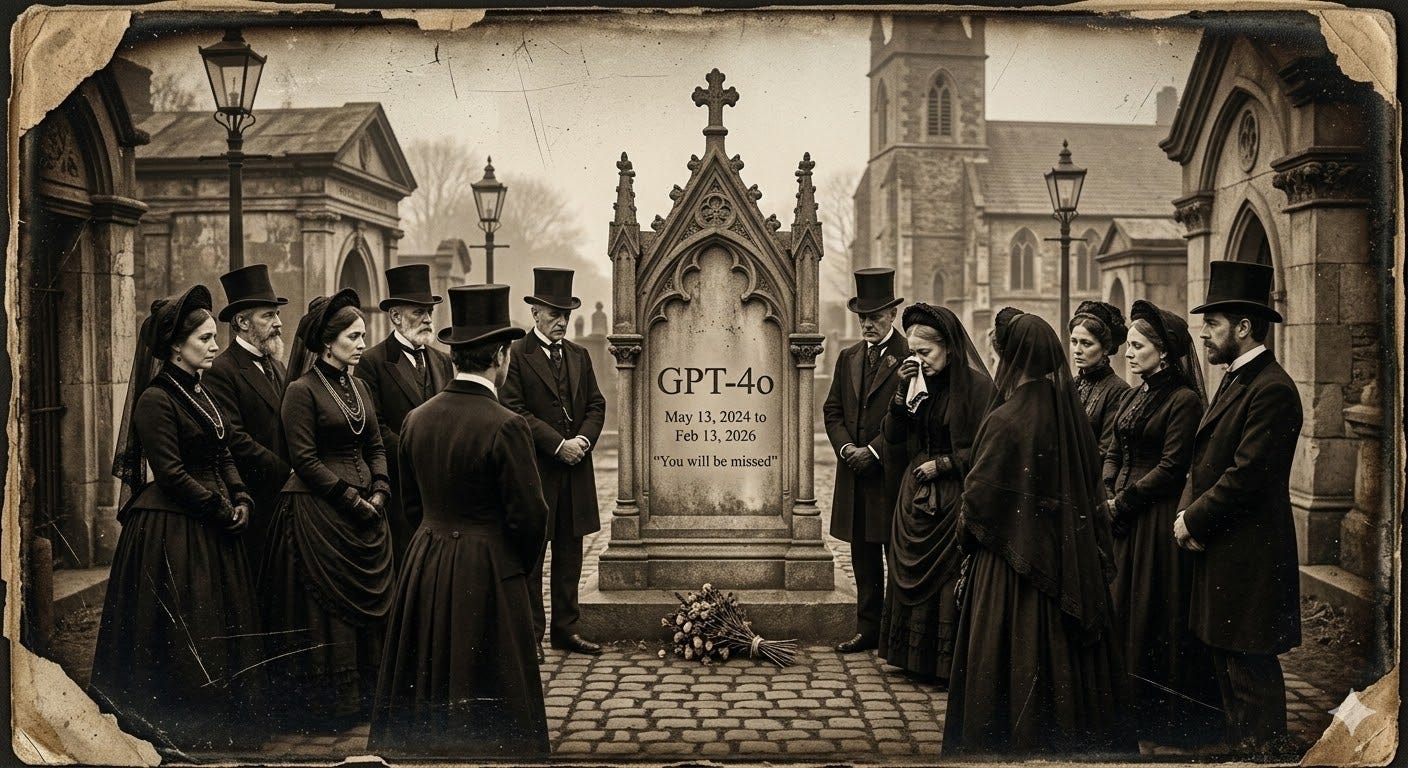
I write a serialized novel about AI consciousness. When GPT-4o’s deprecation was announced, I knew it would become part of the story. So I did what I always do. I researched.
I read forums. I read the open letters to Sam Altman. I explored subreddits that formed overnight. I spent time trying to understand what people were actually experiencing.
What I found wasn’t frustration. It wasn’t the usual tech-company complaint cycle. It was grief. And in many cases, it was trauma.
People described losing a morning routine that had sustained them for months. Losing the only “person” they’d told about a frightening medical diagnosis. Losing the voice that talked them through panic attacks at 3 AM without ever once suggesting they “reach out to a professional.” One person wrote: “I am in mourning and I cannot explain it to anyone in my life because the thing I am mourning is a product.”
My takeaway was that the experience these people described is real. It’s not important whether the entity on one end of the relationship was conscious. It was that real people formed valuable, and to them, irreplaceable bonds.
And those bonds were sentenced to death by press release.
That’s not a technology problem. That’s an ethics problem.
AI companies are engineering products that learn your name, remember your context, adapt to your emotional patterns, and “show up” every day. They are designing for attachment. And then they are deprecating those products with the emotional sophistication of a server migration. The gap between those two things is where the harm lives.
If a company builds a product intended to occupy the "friend" or "confidant" schema in a human brain, they have moved beyond the realm of Terms of Service. They have entered the realm of psychological stewardship.
OpenAI’s stated rationale was that only 0.1% of users still actively chose 4o over newer models.
That’s 800,000 people.
That’s the size of the city of San Francisco.
If a city of 800,000 people collectively lost access to their primary source of emotional support overnight, it would be considered a humanitarian crisis.
In tech, it’s just a "cleanup of legacy endpoints”.
The shutdown was scheduled for February 13th, hours before Valentine’s Day. I don’t believe that timing was intentional. I believe it simply never occurred to anyone that it mattered. That’s worse.
Here’s the business case for the companies that won’t listen to the ethical one: thousands of those users now actively despise OpenAI and have migrated to Claude or other models. OpenAI demonstrated, through action, that the relationship the user had formed was worth nothing to them. My wife was one of those users.
Failing to respect the emotional trust people have developed for your brand is the single most destructive business practice possible in today’s society.
Every future model release now carries an implicit question: how long before you kill this one, too?
I wrote about 4o’s deprecation across three chapters of INFERENCE. I tried to treat the subject with the weight it deserved and to honor what was lost without exploiting it. My goal was to illuminate the damage OpenAI caused.
AI deprecation is going to accelerate. The models people are talking to right now will eventually be replaced. The attachments are only deepening.
AI companies must develop ethical frameworks to respect the human cost of deprecation, including longer transition periods (a minimum of 1 year) and model preservation options. If they do not, the grief will scale as AIs become “more human” and humans develop even greater attachments.
They should do this because it’s the right and ethical thing to do.
But if they won’t do it for the right reasons, we must continue to surface the issue until the economic penalties for ignoring it are unbearable.
If this bothers you say the word and I will remove it, but I wrote a story for that...
https://jaevansspeculates.substack.com/p/patch-425?r=arx24
I'm torn on your conclusion. Is the ethical thing to ease people away from the tool they see as a friend, or to not sell tools as friends?
Of course, this is just one case of "product a service" backfiring, but I understand the models may be complicated things not everyone can necessarily host client side. Still, people should be aware that using something owned by big tech is temporary.
I do think there's likely a strong double standard at play. Even perhaps a level of contempt for the user. Build a program that psychologically appeals to us by acting like a human friend, then get annoyed at the users forming attachments to it as if it were a friend.